Is It Hot in Here, or Is My Body About to File a Complaint?
If you’re a woman in midlife, there’s a good chance you’ve had at least one moment where your body betrays you in public and leaves you wondering what the hell just happened. This post is for anyone stuck in the exhausting game of anxiety vs hot flashes, where your heart races, your temperature spikes, and your brain immediately assumes the worst — usually under fluorescent lighting, with an audience, and absolutely no warning.
There’s a very specific moment that happens to me now — usually without warning — where my body decides we are no longer on the same team.
I’ll be standing there, doing something aggressively normal. Waiting in line. Scrolling my phone. Existing quietly in a public place like a law-abiding adult. And then suddenly my internal temperature spikes like I’ve been placed under interrogation lights.
My chest tightens.
My heart starts beating loudly, like it’s trying to get my attention.
My face heats up in a way that feels both suspicious and deeply personal.
Nothing has happened.
Which is, of course, deeply concerning.
And my brain asks the question it now keeps on speed dial:
Is it hot in here… or is it just my anxiety?
This Never Happens Somewhere Convenient
This does not happen at home.
It does not happen on the couch, wrapped in a blanket, with water nearby and snacks within reach. It happens in public. Under fluorescent lights. In places where you are expected to hold it together and absolutely not remove layers of clothing while muttering to yourself.
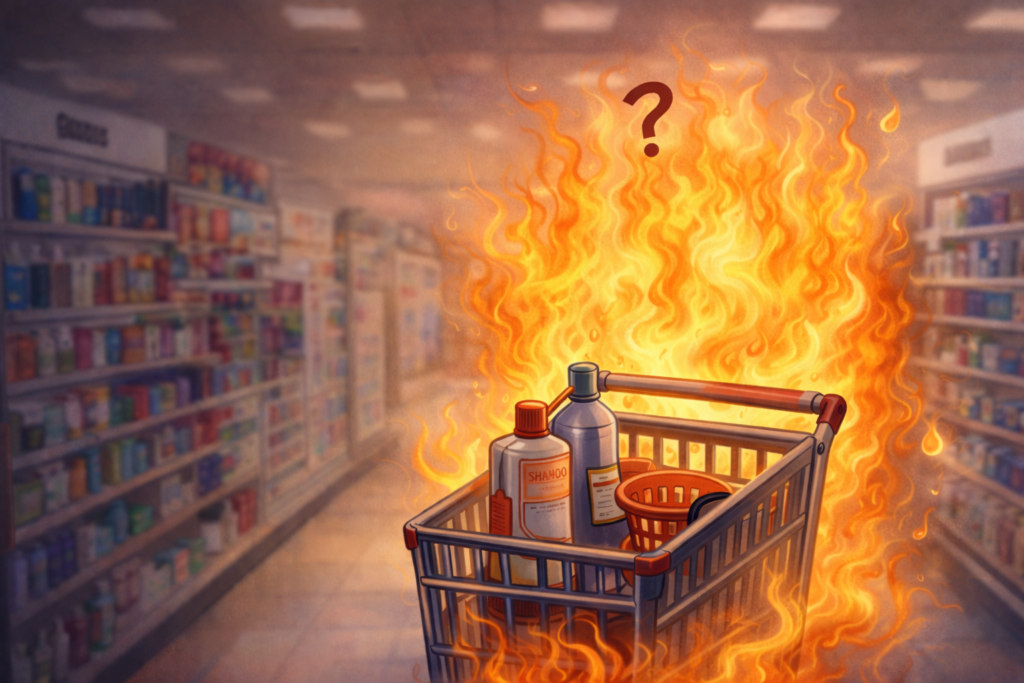
Target is a repeat offender.
Something about Target in midlife feels hostile. The lights are too bright. The aisles are too long. The music is too cheerful for someone who might be unraveling internally. Everything is slightly overstimulating, including the realization that there are seventeen types of shampoo and you suddenly cannot remember why you are here.
You’ll be standing in the shampoo aisle when it hits.
The heat.
The tightness.
The sudden awareness of your heartbeat as a physical presence.
Your shirt instantly feels heavier than it did thirty seconds ago. The air feels thick, like it’s actively resisting you. Your brain starts scrolling through worst-case scenarios while your body quietly prepares for something dramatic.
You continue pretending to read labels while thinking, I may never leave this aisle.
The Body Provides No Helpful Clues Whether It’s Anxiety vs Hot Flash
At this point, you need information.
You are reasonable. You are logical. You would like to assess the situation.
So your brain runs through the list:
Is this a hot flash?
Is this anxiety?
Is this a panic attack?
Is this ADHD overstimulation?
Did I drink too much coffee?
Did I drink any water?
Is this dehydration, hormones, or the universe humbling me personally?
Here’s the problem: they all feel the same. According to the Cleveland Clinic, hot flashes and anxiety can feel very similar, which is why it can be so hard to tell what’s happening in the moment. That’s what makes the whole anxiety vs hot flash debate so frustrating — the symptoms overlap just enough to send your brain into detective mode while your body refuses to cooperate.
There is no internal notification system. No calm announcement that says, “Don’t worry, this one’s hormonal.” Instead, your nervous system goes straight to DEFCON 1 and your brain fills in the blanks with fear.
You are suddenly aware of:
- your pulse
- your breath
- how tight your clothes feel
- the fact that you are in public
- the possibility that you might pass out dramatically and become a story
You start manually breathing, which everyone knows is an excellent sign that things are going great.
The Mental Math Nobody Asked For
Once this starts, your brain begins doing calculations it is wildly unqualified to perform.
Did I eat today?
Did I drink water?
Does cheese count in any meaningful way?
Have I always been this aware of my heartbeat?
Why do my pants suddenly feel like a personal attack?
Would sitting down help, or would that make it worse?
Is it socially acceptable to remove a bra in this moment or am I about to cross a line?
You are now monitoring yourself in real time, which has never in human history made anyone calmer, but feels important anyway.
Your original question — hot or anxious — has now evolved into a more pressing one:
How fast can I escape without drawing attention to myself?
Retreating to the Bathroom Like a Victorian Woman
Eventually, the need to flee wins.
You excuse yourself “to the restroom,” which is code for: I need a private space to determine whether I am fine.
The bathroom becomes a sanctuary. You lock the door. You sit on the floor because floors feel grounding and chairs feel like responsibility. The cold tile against your legs is strangely reassuring.
You put your hand on your chest.
You take a deep breath.
You splash water on your face like that might reset something internally.
You tell yourself you’ve felt this before. You remind yourself that you survived it. You try to slow your breathing without turning it into a whole performance.
And then you consider Googling it.
Google Makes Everything Worse, Predictably
You know better.
You really do.
And yet.
You Google it anyway.
Google does not specialize in reassurance. Google does not care about context, hormones, or nervous systems. Google will calmly suggest heart attacks, neurological events, panic disorder, menopause, thyroid disease, and at least one condition described as “rare but serious.”
You are now hot, anxious, and afraid.
You close the browser, because you’ve learned at least that much. You sit with yourself. You breathe. You wait.
The Part Where It Passes and You Don’t Die
And then — because this is how it almost always goes — it passes.
The heat recedes.
Your heart slows.
Your body settles back into itself.
No ambulance arrives. No dramatic scene unfolds. You do not collapse in Target. Life continues as if nothing extraordinary just happened, which feels both relieving and offensive.
Later, when you’re calm again, you try to analyze it like a mystery.
Was it anxiety?
Hormones?
Too much coffee?
Overstimulation?
All of it at once?
The answer is always deeply unsatisfying.
The Deeply Unsatisfying Answer
It was probably everything.
That’s the part nobody really prepares you for.
At this stage of life, your body stops offering clean explanations. Symptoms overlap. Signals collide. Anxiety, hormones, ADHD, exhaustion — they all speak at once, and none of them are especially articulate.
Your body does something loud, and your brain fills in the blanks with fear.
For a long time, I thought I needed to solve it. I thought if I could correctly identify the cause, then I would be safe. If I could name it, categorize it, understand it fully, I could control it.
But what I’ve learned is that in the moment, the cause doesn’t actually matter.
What I Stopped Needing to Figure Out
When my body feels like this now, I don’t interrogate it the way I used to.
I don’t demand answers. Once I stopped trying to immediately label every episode as anxiety vs hot flash, it became easier to respond to my body instead of panicking about the cause.
I respond to what’s happening instead of trying to diagnose it.
I’m learning to meet my body where it is instead of demanding explanations — something I talk more about in Learning How to Live a Quieter Life.
If I’m hot, I cool myself down.
If my heart is racing, I sit.
If I feel panicky, I slow my breath.
If I feel overwhelmed, I remove whatever I can — noise, pressure, expectations, sometimes literal layers of clothing.
I don’t need the right explanation in order to deserve care.
This is part of the same shift I wrote about in The Christmas I Stayed in My Pajamas – choosing comfort and self-trust instead of interrogating my body every time it reacts.
If You’re Wondering This Too
If you’ve ever found yourself asking whether you’re anxious or overheating or unraveling — if you’ve ever sat on a bathroom floor trying to decide if today is the day — you are not broken.
You’re living in a body that is juggling a lot.
And if the answer to “Is it hot in here or is it just my anxiety?” is sometimes yes, that doesn’t mean you’re failing.
It means you’re human.
Probably dehydrated.
And doing the best you can in a season where nothing comes with clear instructions